Why Do Candles Tunnel? Causes and Fixes
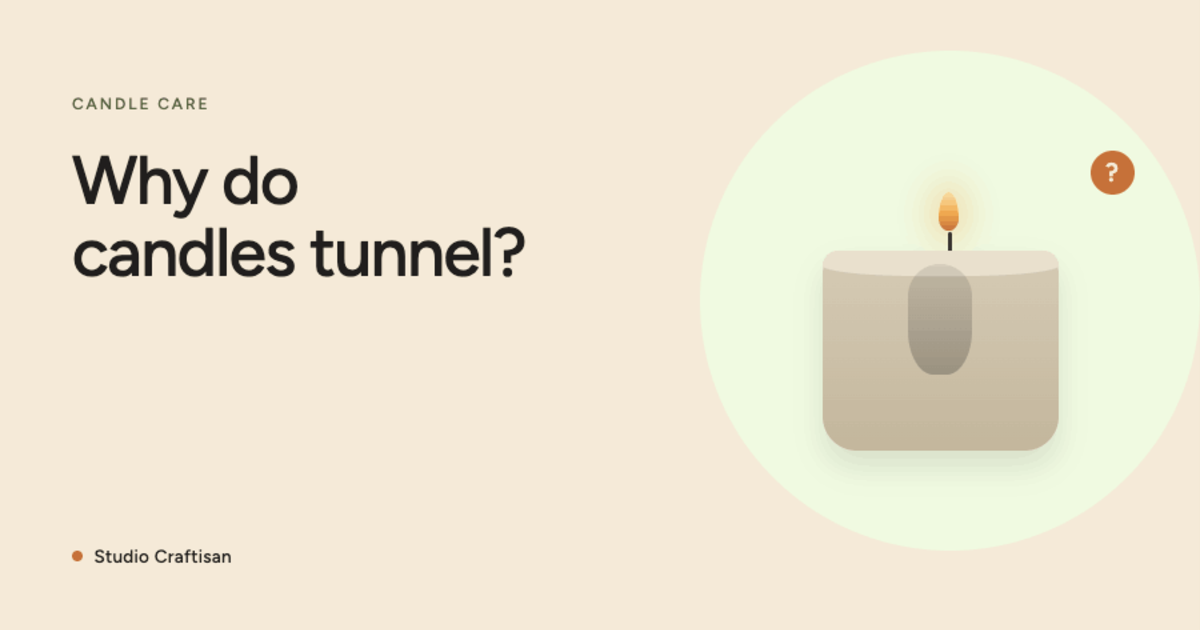
Why do candles tunnel? The short answer: either the wick is not strong enough, or the first burn was cut short. Tunnelling is when a narrow well forms in the middle while the wax at the edges never melts. The result is that you cannot use half the candle, the scent weakens, and the flame eventually disappears down inside the vessel.
The good news is that most tunnelling can be reversed, and nearly all of it can be prevented. Here are the causes and the fixes.
What Causes Tunnelling
- The first burn was cut short. By far the most common cause. A candle forms a memory; wherever the melt pool reached on the first burn is where it will stop on every burn after.
- The wick is too thin for the vessel. A manufacturing issue that cannot be fully fixed at your end, only mitigated.
- The wick was trimmed too short. Below 3 mm it cannot generate enough heat.
- It was burned in a draught. The flame leans to one side and the melt becomes uneven.
- A wide vessel with a single wick. Wide diameters need multiple wicks.
The First Burn Rule
The first time you light a candle, wait until the entire top surface liquefies and reaches the edges of the vessel. Depending on diameter this can take 1-4 hours. Skip it and the candle will follow that narrow well for the rest of its life.
It matters most in concrete vessels, because concrete absorbs heat and the edges take a little longer to melt.
How to Fix a Tunnelled Candle
Method 1: Foil
- Light the candle and let it burn normally.
- Cover the top with aluminium foil, leaving a hole in the middle for the flame to breathe.
- Wait 1-2 hours. The foil reflects heat back to the edges and softens the hard wax.
- Remove the foil and let it burn until the surface levels out.
Method 2: Level it with a spoon
For mild tunnelling, carefully scrape the excess wax from the edges with a spoon or blunt knife to level the surface. The wax you remove can be used as a wax melt.
Method 3: Heat gun or hairdryer
On a low setting, melt and level the top layer. Fast, but overheat it and you can drown the wick - go gently.
Five Rules to Prevent It
- Let the surface melt to the edges on the first burn.
- Trim the wick to 5 mm before every burn.
- Never burn for more than 4 hours at a time; overheating damages both vessel and scent.
- Keep it away from draughts.
- Choose wooden wick candles; the horizontal flame creates a wider melt pool.
Full guides: Candle Care: 5 Rules and Wooden Wick vs Cotton Wick
Which Candles Tunnel Less?
Wooden wick candles produce a horizontal flame, so the melt pool widens faster and the risk drops noticeably. In concrete vessels the material spreads heat evenly, which also makes the melt more balanced.
- Night Storm - wooden wick, wide melt pool
- Winter Wonderland - multiple wooden wicks in concrete
See our wooden wick candles and concrete candles.
What Candle Memory Actually Is
"Candle memory" isn't marketing language, it describes a measurable physical process. When a candle burns, the wick creates a liquid melt pool, and the edge of that pool marks the boundary between liquid and solid wax. Once the flame goes out, the liquid wax re-solidifies, but not randomly: the triglyceride crystals that make up soy wax realign starting from wherever the previous melt line ended. In effect, the wax stores a molecular record of its last burn, and that record determines how far the next melt pool is able to spread.
This is why the diameter of the very first melt pool matters so much. The narrower that first boundary is, the harder it becomes for liquid wax to spread past it on later burns; the crystal structure behaves as if it has learned where the edge of the pool is supposed to stop. Paraffin shows this effect less because its crystal lattice is looser and less uniform; soy wax packs its crystals more tightly and more evenly, so the memory effect is stronger and more consistent. That's also why tunneling in soy candles tends to repeat at almost exactly the same diameter, burn after burn; the wax is, in a real sense, holding onto a pattern, and it won't erase that pattern on its own. Room temperature and cooling speed during the first burn also shape how tightly the crystals pack, which is part of why two candles from the same batch can develop slightly different tunnel widths.
Early Diagnosis of Tunneling
Tunneling is rarely obvious on the first burn, it shows up on the second or third, which is exactly when it should be checked. Once the candle has cooled and fully solidified, look at the rim: a solid wax ring of 3 to 5 millimeters is normal and nothing to worry about, since that thin layer usually melts away on the next burn. The real concern starts once that ring passes 8 to 10 millimeters, which is a clear sign the melt pool isn't reaching the container wall, and that thickness tends to grow with every burn that follows.
A simple way to track this is to photograph the candle from above after every burn and measure the pool diameter with a ruler. If that diameter stops growing across two consecutive burns, or shrinks, the candle has entered tunneling territory. It also helps to watch the pool's depth: a healthy burn keeps the pool relatively shallow, while a tunneling candle develops a deeper, narrower well over time. The latest point to intervene is generally the third burn; wait until the fourth or fifth and the solid rim has thickened enough that fixing it takes far more heat and time, and in some cases the wax at the edge won't fully melt again at all.
Tunneling vs. Look-Alikes
Not every uneven surface is tunneling, and mixing these up leads to unnecessary worry or the wrong fix. Frosting, the white, crystalline bloom that sometimes appears on the surface of soy wax, is a cosmetic result of the same crystallization process described above; it has nothing to do with how deep the melt pool goes and doesn't affect burn time at all. A thin film of wax clinging to the container wall after a burn is also harmless on its own, it's just residue that didn't fully re-liquefy, not evidence of a growing rim.
Uneven melting, where the pool tilts to one side or leaves a lopsided edge, is usually a draft or wick-centering issue rather than tunneling, and it tends to correct itself once the airflow or wick position changes. True tunneling has one specific signature: a straight-walled, symmetrical column of melted wax surrounded by a solid rim that keeps its thickness, or grows, across multiple burns. If the rim measurement isn't increasing while everything else looks fine, it's worth checking the wick and pool diameter rather than assuming the worst, since a single odd-looking burn on its own rarely means the candle is tunneling.
Frequently Asked Questions
Can a tunnelled candle be saved?
Usually yes. The foil method works for mild to moderate tunnelling. If the wick is fully buried under wax it is hard to recover.
Does the first burn really need 4 hours?
It is the result that matters, not the clock. Once the surface has melted to the edges you are done - 1 hour for some candles, 3-4 for wide vessels.
How short should I trim the wick?
5 mm for cotton, 3-5 mm for wood. Shorter means too little heat; longer means soot.
Does soy wax tunnel more?
Soy melts at a lower temperature than paraffin, so the first burn rule matters more with soy. Used correctly it makes no difference.
Will tunnelling fix itself as the candle burns?
No - it deepens. Deal with it as soon as you notice it.
The Candles Behind This Guide
All are made by hand in Izmir from 100% natural soy wax with wooden wicks:
- Saf Pamuk: clean cotton and fresh laundry.
- Sessiz Şafak: soft morning florals.
- Zihin Dinginliği: calming lavender and sage.
For more options, browse our soy candles and wooden wick candles pages.