How to Spot a Natural Candle: Organic Candle Buying Guide
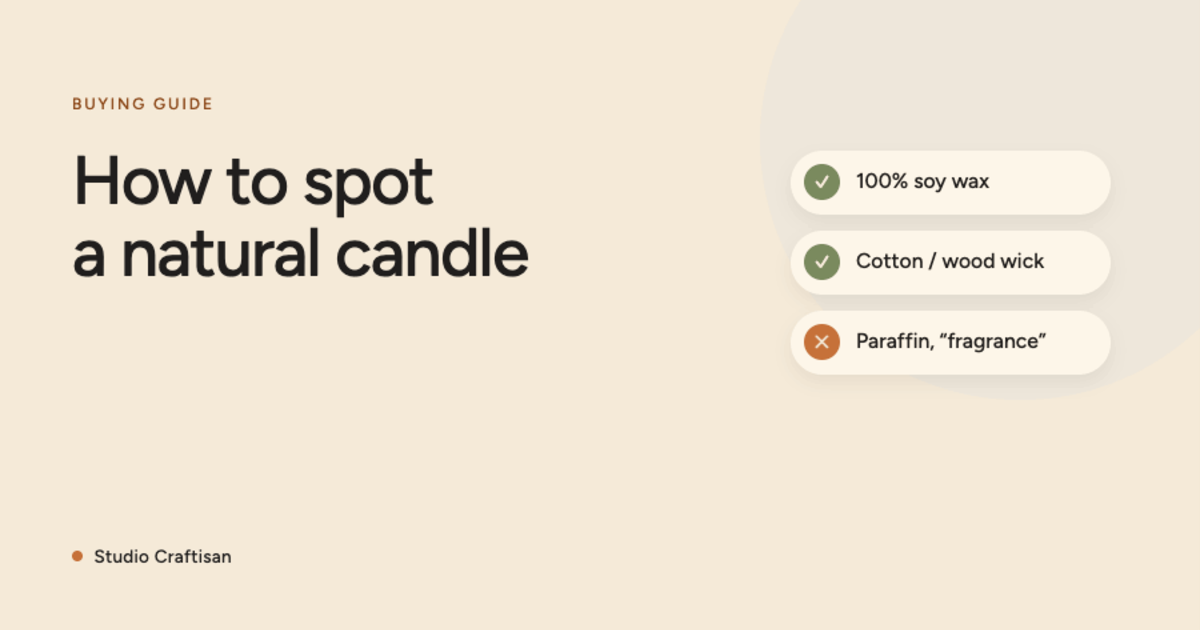
"Organic" and "natural" labels are everywhere — but not every candle deserves them. A paraffin candle is a petroleum product no matter what the label says. Here is a practical checklist for buying a truly natural candle.
1. Check the Wax
- Soy wax: plant-based, clean and slow burning — the most common natural wax.
- Beeswax: fully natural with a subtle honey scent.
- Coconut-soy blends: natural with a smooth finish.
- Paraffin: petroleum-derived; cheap but sooty — not natural.
If the wax type isn't stated, ask the seller. A transparent maker always answers.
2. Look at the Wick
Natural candles use cotton or wooden wicks. Wooden wicks also crackle softly as they burn — a lovely fireplace feel.
3. Question the Fragrance
Candles scented with natural fragrance or essential oils smell softer and more balanced — no headaches. Botanical notes like lavender, sandalwood and patchouli work beautifully.
4. Handmade or Factory-Made?
Handmade candles are poured in small batches by makers who know exactly what goes into them. They are craft objects — each piece slightly unique, perfect for gifting.
5. Vessel and Packaging
Reusable vessels (concrete jars, glass) are eco-friendly and live on as decor after the candle is finished. Avoid single-use plastic.
Natural Handmade Candles at Studio Craftisan
All of our candles are hand-poured in İzmir with 100% natural soy wax and cotton or wooden wicks. Browse our natural soy candles or read our guide to soy wax.
What "Organic," "Natural," and "100% Soy" Actually Mean
In the candle industry, the word "organic" isn't held to the same regulatory standard as it is in food or cosmetics. There is no widely recognized, dedicated certification system for "organic candles" the way there is for organic produce. Organic agriculture regulations mostly cover food, textiles, and certain cosmetic raw materials, not finished candles. So when a candle is labeled "organic," it usually reflects the brand's own description rather than independent verification.
"100% soy wax," on the other hand, is a more concrete claim, because it describes a measurable ingredient: the entire wax blend is soy-based. Still, that phrase alone says nothing about whether the fragrance is natural, whether the wick contains lead, or whether the container is recyclable. "Clean burning" is another term you'll see often, but it has no formal industry definition. When a brand uses it, that's a self-assessment, not a lab result.
The most practical way to spot greenwashing is to check whether the language is backed by specifics. Phrases like "eco-friendly," "pure scent," or "100% natural" mean little on their own if there's no accompanying detail about wax ratio, wick material, or fragrance source. A brand that's confident in its product will back up its claims with numbers and an actual ingredient list, not just adjectives.
What Should Always Be in a Product Description
A candle's label or product description tells you a lot about how transparent the brand actually is. Before you buy, check whether these six details are clearly stated.
- Wax type and ratio: pure soy wax, or a soy-paraffin blend, and if it's a blend, what percentage is soy. "100% soy wax" and "soy-based blend" are not the same product.
- Wick material: cotton, wood, or metal-core. If it's metal-core, the listing should confirm it's lead-free.
- Fragrance load and source: the fragrance-to-wax ratio, typically 6-10 percent, and whether it comes from natural essential oils or synthetic fragrance oil.
- Net weight: the wax weight in grams, not including the container.
- Estimated burn time: given in hours, ideally with the burning conditions specified, such as 3-4 hour sessions.
- Place of production: which workshop and city the candle was made in.
Missing one or two of these details doesn't automatically mean the product is bad, but it does mean you should ask the seller directly. If a simple question like "what's your wax blend?" or "what's the wick made of?" doesn't get you a clear answer, that gap in information is itself worth paying attention to.
What Price and Your Senses Can Tell You
There are concrete reasons natural candles cost more than mass-produced paraffin ones. Soy wax typically costs two to three times as much per kilogram as paraffin, and handmade production, small batches, longer cooling times, adds labor cost on top of that. That's why comparing total price is less useful than comparing cost per gram. A 200-gram candle priced at $12 works out to 6 cents per gram; a 100-gram candle at $5 works out to 5 cents per gram. What looks cheaper at first glance may just reflect a smaller size.
Cost per hour of burn time is another useful measure. A candle that burns for 45 hours and costs $22 comes out to roughly 49 cents per hour. A very cheap candle usually cuts a corner somewhere that doesn't show up in that math: a higher paraffin ratio, a synthetic fragrance oil used to keep costs down, or a thin, lower-quality wick.
When you pick up a candle, a few things are worth checking. The surface should be smooth and even; noticeable sinkholes or air pockets usually point to a rushed pour. Natural soy wax tends to be cream or off-white in color; if the surface looks unnaturally bright white and glossy, that's worth questioning. The scent should be faintly noticeable even through the packaging, without being overpowering. A sharp, chemical-smelling scent often signals a heavy synthetic fragrance load. The weight of the container is another clue; well-made containers usually feel noticeably substantial.
Once it's burning, there are three things to watch: flame height, soot, and the melt pool. Under normal conditions the flame should sit around 1 inch tall, steady, without flickering. There shouldn't be soot building up on the inside of the container or on the lid. On the first burn, the melt pool should reach all the way to the edges of the container; if it doesn't, the candle will start to tunnel, burning down the middle and wasting the wax around the edges.
Frequently Asked Questions
Is there an official certification for organic candles?
Right now, there's no widely recognized, independent certification for "organic candles" comparable to organic food certification. Some brands hold agricultural certifications for their wax's raw material or recycling certifications for packaging, but these don't cover the finished product as a whole. Rather than looking for a certificate, it's more reliable to look at the ingredient list and how transparent the maker actually is.
If it says "100% soy" on the label, can I trust it?
That phrase gives you solid information about the wax itself, and it's generally a more reliable signal than a paraffin blend. But it says nothing about fragrance source, wick material, or the container. If "100% soy wax" is paired with clear information about the wick and fragrance too, you're getting a much fuller picture of the product.
Why are natural candles more expensive?
Soy wax costs more as a raw material than paraffin, production usually happens in small handmade batches, and natural essential oils cost more than synthetic fragrance oils. These factors add up to the price difference; when comparing candles, looking at cost per gram or cost per hour of burn time gives you a fairer comparison than the sticker price alone.
Is an unscented candle more natural?
Not necessarily. Being unscented doesn't say anything about the wax itself, and an unscented candle can still be paraffin-based. What actually determines how natural a candle is comes down to the wax type, the wick material, and the fragrance source, if any, not whether it has a scent at all.
How can I tell if a soy candle is mixed with paraffin?
Start with the wax ratio on the label; phrases like "soy-based" or "soy blend" usually signal that some paraffin is mixed in. Pure soy wax also tends to be softer and more matte at room temperature, while candles with a higher paraffin content tend to be harder and glossier. If you're not sure, asking the maker directly for the exact ratio is the clearest way to find out.
You Might Also Like
The Candles Behind This Guide
All are made by hand in Izmir from 100% natural soy wax with wooden wicks:
- Sessiz Yaprak: green leaf and freshness.
- Zeytin Dalı: Aegean olive blossom.
- Zihin Dinginliği: calming lavender and sage.
For more options, browse our natural candles and soy candles pages.